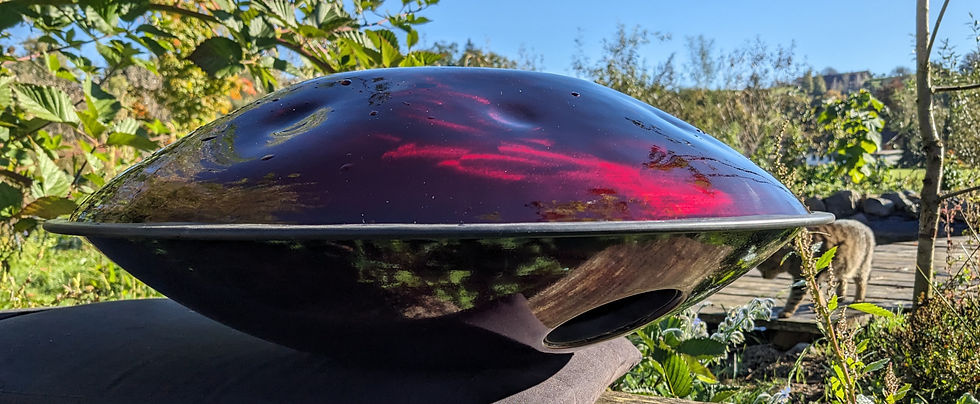
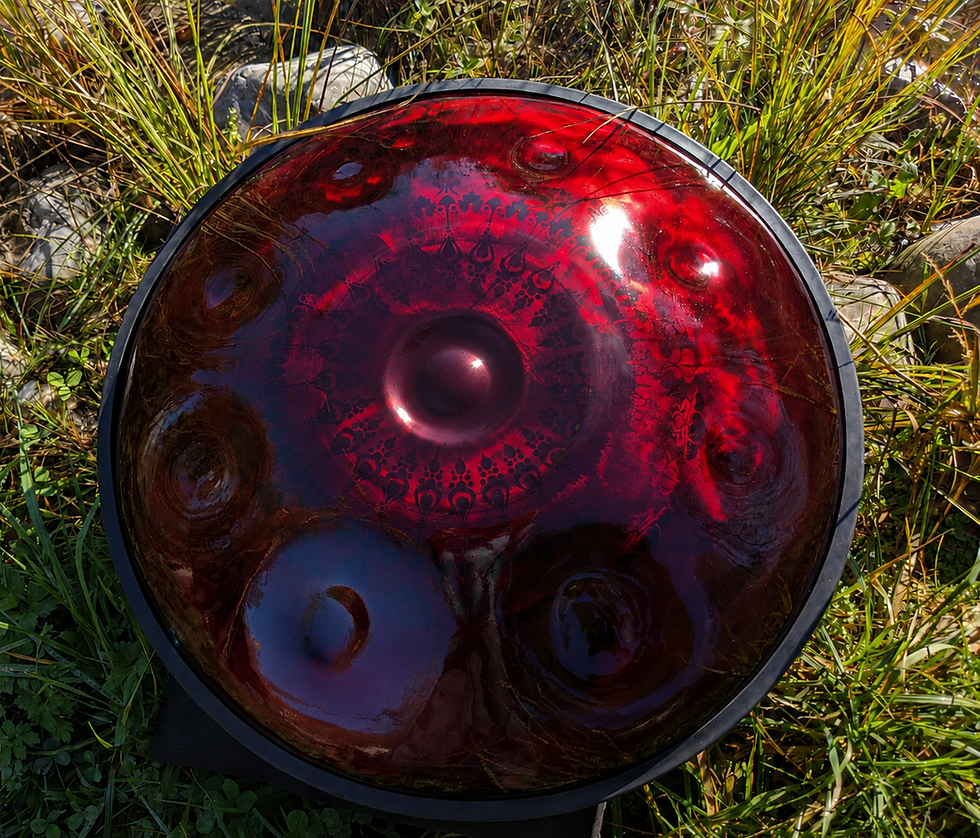
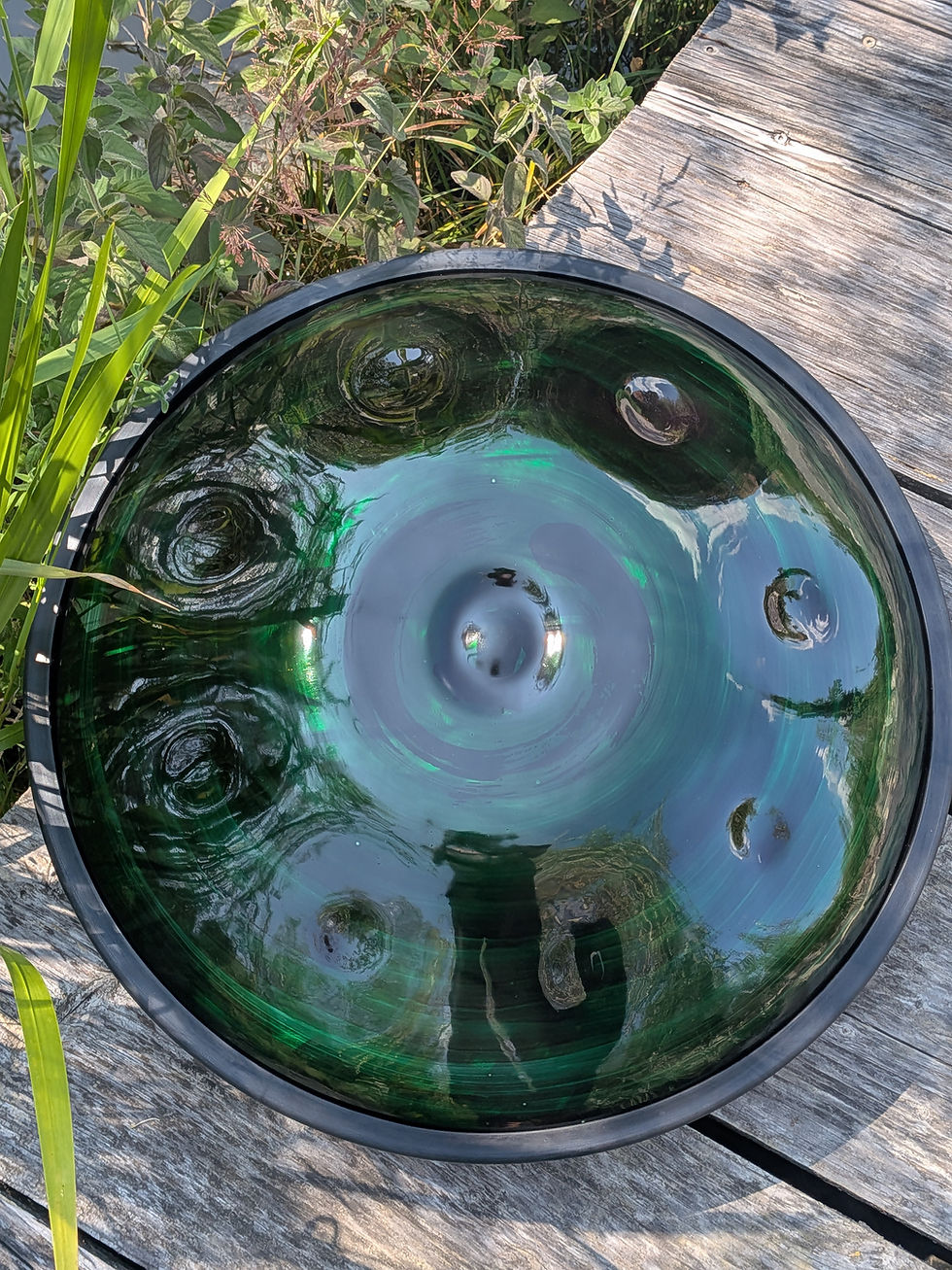
One of the main features of the LUNA scales is the use of also pure intonation as opposed to the most commonly used modern midrange temperament.
This ensures that all intervals are tuned very clearly and purely and the internal resonance is significantly increased.
Although I will try to keep the explanation simple, we will have to dive a little into music theory to fully understand this:
First of all, we have to understand that scales are never defined by notes - they are defined by a certain combination of interval steps (which can then be represented by notes).
So what is an interval?
Well, let's pick any frequency as a fundamental - just imagine a plain string, like a guitar string or another. It doesn't matter how long this string is, but for simplicity's sake we assume it's 1 meter long.
So this is our basic frequency - or the tonic of our scale.
Imagine now, we take a finger and pluck this string - it will start to vibrate as follows (in reality it vibrates in many more ways, but these are irrelevant to us at first) and emit a tone.
Our fundamental - let's say it is a C3.
We can now define this frequency in a simple mathematical term as 1 or - we will need this later - as a ratio of 1/1 equal to 1.
Based on this, we now create our first interval step, which is one of the most important: the octave.
The octave sounds like exactly the same note - but a "step" above our foundation, and it has twice the vibration frequency as our fundamental.
On our string, the octave would fibrillate so and can be mathematically defined as the double frequency, tso 2 ( 2x1) or the ratio: 2/1
So now we have our base frequency, with the ratio 1/1, of which we said it was C3 (but it could be any other note) and we have our octave, which is the ratio 2/1 and thus a C4.
These are the limits within which we create a scale. Everything that goes above or below these octaves is just a repetition that we don't have to worry about now.
So let us take the second most important interval, which is the fifth.
The fifth is perceived as a very pleasant interval step and is so important that the entire Western 12-note system is based on it, namely on the quint-layering.
On our string, the fifth would vibrate as follows:
To make the fifth sound, we would have to shorten our string, for example, like a guitar player shortens a string when he picks it off with his finger.
This should be done in the ratio 3/2, which is the ratio of the pure fifth:
In our example of the C3, the fifth with the ratio 3/2 would be G4.
Starting from here, the chromatic scale of Western music was constructed, which places fifths on fifths.
So let's start from C and look for the fifth of it, the G.
If we repeat this step and look for the fifth to the G, we come to the D.
On the keyboard of the piano, we always move 7 semitones to the right.
We can also calculate the ratio of this D.
This is done simply by multiplying the G -> 3/2 by another fifth step, i.e. 3/2, and then going an octave lower.
It looks like this:
3/2 x 3/2 = 9/4
Now that we have exceeded the octave point, however, we must lower the result by one octave so that we are again within the correct octave and thus receive the D as the second after the C.
For this we have to divide the result by the ratio of the octave we said to be 2/1:
9/4: 2/1 = 9/4 x 1/2 = 9/8
The perfect D, as derived from the quint layering, would therefore have a ratio of 9/8.
In our drawing its oscillation would look like this:
And here is how those frequencys would vibrate differently on our string:
the tonic - octave - fifth - the second
Now that we understand this, we can see how the 12 notes are created in Western music - they are all created as a fifth from the fifth from the fifth from the fifth from the fifth.... here is the complete series of fifths that begins with C, followed by the fifth of C = G followed by the fifth of G = D etc..
C -> G -> D -> D -> D -> A -> E -> E -> B -> Gb -> Db -> Ab -> Eb -> Eb -> Bb -> F -> C
That is why European music has 12 notes, because after 12 such operations you reach FAST - but only almost - the opening note, the C.
And this is where the problem and the various attempts to solve it, such as the mid-tone temperament, begin.
Mathematically speaking, the multiplication of fifths is always a multiple of 3/2.
Or, if we want to represent the ratio as a decimal number: 3/2 = 1.5 multiples of 1.5.
So we have multiples of 1.5 which we can also write as a superscript 1.5^2 ( 1.5 x 1.5).
The core problem is that we calculate with the ratio 2/1, i.e. with multiples of 2 ( 2^2 ; 2^3 ; 2^4 etc.) in order to get perfect octaves.
But unfortunately these two never fit together perfectly.
You can demonstrate this by looking at where a multiplication in octave steps ends after a complete octave:
Namely after 2 x 2 x 2 x 2 x 2 x 2 x 2 = 2^7 (because we created 7 whole tones between one octave) = 128
And here ends the series of multiples of 1.5 ( thus the quint layering ) after 12 steps ( since we produce 12 semitones ):
1,5 x 1,5 x 1,5 x 1,5 x 1,5 x 1,5 x 1,5 x 1,5 x 1,5 x 1,5 x 1,5 x 1,5 x 1,5 = 1,5 ^12 = 129,75
So we have the result 128 once and 129.75 once.
As we can see, perfect octaves can never be matched with perfect fifths or interval steps. It seems that we have to decide... perfect octave or perfect intervals...
What are the solutions?
Well, great thinkers have been thinking about it for centuries, starting with one of the first, Pythagoras, but also Kirnberger, Bach and many other musicians and composers have developed their own suggestions and methods to solve this problem.
At the moment we will not go into these like e.g. the Pythagorean tuning or others.
Suffice it to say that there are hundreds of different temperaments and tuning methods. ( Alone in Europe - not to mention completely different methods in different cultures! )
The most common type of tuning today to deal with this problem is the so-called mid-tone tempering, which is also the widespread standard for Handpans.
We have seen that we end with multiples of perfect fifths at 129.75, while the perfect octave ends at 128.
The difference between these two is the so-called "Pythagorean comma" which is calculated as follows: 129.75 - 128 = 1.75
This difference would produce an audible dissonance in the last interval step, or - with perfect intervals - make the octave appear clearly too high.
The mid-tone tempering deals with this problem as follows:
We take the Pythagorean comma - 1.75 and divide it by 12 - because we have 12 interval steps - and then distribute this error evenly over all intervals.
So 1.75 : 12 = 0.145 on each of the 12 interval steps to achieve a perfect octave.
This means, for example, if the perfect ratio of e.g. a fifth is 3/2 = 1.5 in the pure tuning.
then it is now 1,645 in the mid-tone temperament.
A mid-tone fifth is therefore slightly higher and slightly out of tune, in contrast to a pure, perfect fifth.
Another example based on the fourth:
The ratio of a perfect fourth 4/3 = 1,333
The ratio of a mid-tone quarter = 1.478
To sum up: The Western mid-tone temperament has only one single, truly natural and pure interval, the octave.
All other intervals must be somewhat impure and out of tune to fit the octave at the end.
Even if the difference seems to be tiny (e.g. from 1.5 to 1.645 for the fifth), it is perceptible to an experienced ear and gives the intervals and especially the chords a restless, impure quality.
So far so good. But if the LUNA is tuned purely, then it doesn't fit the octave at the end, does it?
Yes she does.
The LUNA contains perfect natural octaves in a 2/1 ratio, just like the mid-tone temperament, AND has the perfect intervals in perfect natural ratios, like 3/2 - 4/3 etc.
Since the Handpan is not a chromatic instrument with all 12 semitones, it opens up a special possibility for pure tuning.
For every LUNA tuning there is a certain mathematical calculation in which the "error interval", also called "Wolf's fifth", is mathematically "compressed" and calculated into a note that simply does not occur in the respective scale!
The mathematical error, the non-matching of fifth and octave multiples is shifted until it comes to rest in an interval that does not exist on the instrument.
This must be calculated individually for each individual scale on the LUNA tuning list.
Again summarized in a few words: All LUNA scales are in pure, natural, perfect intonation. They have both perfect interval steps and perfect octaves, because the Pythagorean comma is calculated for each individual scale so that it does not appear on the instrument.
It is not just a mathematical gimmick, because the pure tuning is also naturally perceived by the ear as pure tuning, compared e.g. with the mid-tone temperament.
This is the most natural and cleanest tuning possible in the non-chromatic range.